- Events
-
Partners
- Government
- Customer Portal
- Contact Us
- Contact Sales
-
English
SolarWinds® Security Event Manager (SEM) is designed to process audit log data and audit records from routers, switches, servers, applications, user endpoints, and more before they’re written into a database, facilitating the delivery of log and event correlation in real time.
Using SEM, you can easily access data to help you quickly identify policy violations, malware attacks, multi-vector attacks, and more, ensuring you are able to resolve security breaches and other critical issues before irreparable damage has occurred. Security Event Manager also gives you comprehensive visibility into your IT infrastructure. With this well-rounded understanding of your audit trail database in hand, you can conduct in-depth forensic analyses and gain reliable, actionable insights.
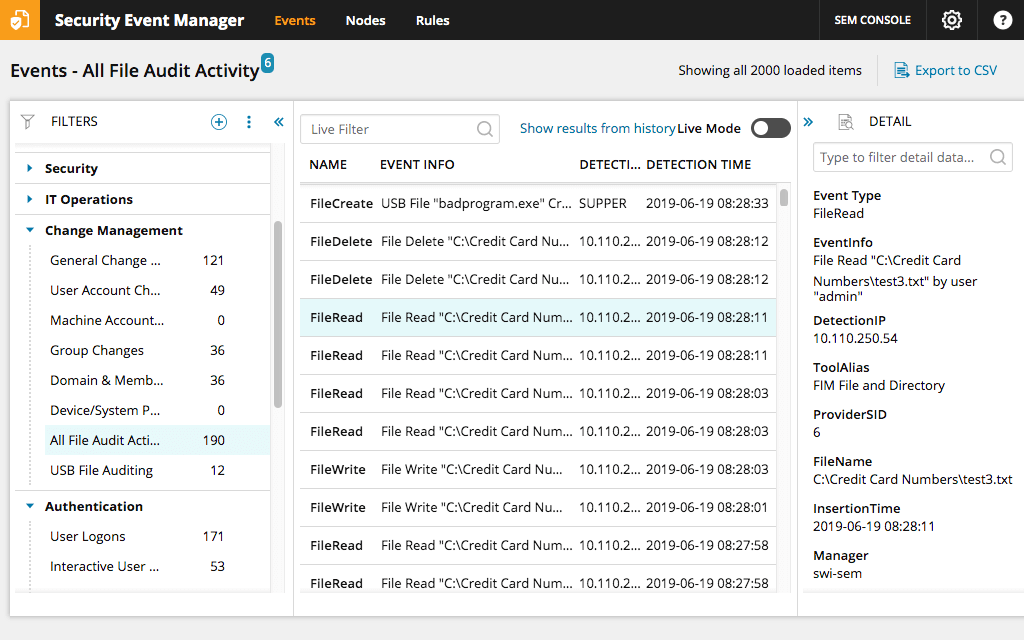
Security Event Manager’s built-in File Integrity Monitoring (FIM) system can help you audit privilege use by tracking which privileged users are accessing which files and folders within your IT infrastructure.
You can use SEM to stay up to date on database activities and identify not only which user is responsible for database changes, but what actions they took before and after those changes were made. Access to this level of insight can help you keep zero-day malware and advanced persistent threats (APTs) at bay, as hackers often seek to modify local files when performing these attacks.
Industry-specific regulatory compliance standards like HIPAA, PCI DSS, SOX, and FISMA require users to implement database security measures and produce in-depth reports to demonstrate compliance—and how they’ll continue to do so.
Security Event Manager is built to provide more than 300 built-in compliance report templates which can be modified to meet the unique needs of each external standard—and any internal ones—making it easier for you to fulfill reporting requests from external auditors and C-suite executives alike.
Security Event Manager is designed to provide in-depth activity monitoring at the database level to help boost data security. By implementing audit log data aggregation across all your devices, you can correlate events in real time, so you can quickly investigate potential security breaches, identify threat patterns, and evaluate unusual privileged user activity—all at a moment’s notice.
SEM can also send alerts when an attacker may have entered your infrastructure when pre-configured thresholds are triggered, allowing you to immediately jump into action. Paired with Security Event Manager’s automated incident responses to help block IPs, change privileges, kill applications, and more, these alerting capabilities can help you remain well prepared to ward off hackers.
Your devices—routers, switches, SQL servers, applications, user endpoints, and more—continuously emit log data, also called log files or records. Database auditing is the act of reviewing monitored database log activity to help inform your ability to protect data and keep hackers at bay.
Auditing database log data can provide insights into events and activities taking place within your IT infrastructure and allow you to more easily identify accessed or modified resources.
Database auditing involves collecting and reviewing log data, which can help you more easily identify suspicious activity and demonstrate to regulators you’re taking measures to help keep data secure. Performing database auditing involves evaluating audit trails to determine which users have accessed data at any given point in time, and what changes to this data the users may have made.
Database auditing can help support your overall security information event management (SIEM) efforts by helping you ensure you’re able to quickly and efficiently identify threats and detect suspicious activity and patterns. This level of insight can also help you make more informed decisions about measures to put in place to can help minimize the impact of an attack should a hacker manage to infiltrate your IT infrastructure.
Database auditing is important for many reasons, most of which revolve around one key element: security. IT infrastructures are susceptible to a range of cyberattacks, including DDoS, botnet, and malware attacks, as well as multi-vector threats.
At the core of many compliance standards are privacy requirements designed to reduce risk. Database auditing can also be an integral part of demonstrating compliance with several government and industry-specific standards, including HIPAA, PCI DSS, SOX, ISO, DISA STIGs, FISMA, FERPA, NERC CIP, GLBA, and GPG13. Database auditing can help inform compliance reporting by helping you monitor your environment in real time to uncover gaps allowing you to make changes and corrections to ensure the business complies with government and industry regulations.
When choosing database auditing software, look for a tool to help streamline the auditing process by collecting, normalizing, and correlating log data from across an IT infrastructure in real time, so you can more easily detect threats, protect file integrity and application security, and demonstrate compliance to auditors.
Some database auditing tools can also aggregate event log data into a single, easy-to-access location, which can help boost your productivity by saving you hours otherwise spent sifting through device logs and attempting to manually correlate events.
A database auditing tool should help inform your security posture by allowing you to more easily stay on top of potential threats by alerting you when pre-configured thresholds have been triggered. Comprehensive database auditing tools may also include automated responses to block IPs, change privileges, disable accounts, block USB devices, kill applications, and more, so you can begin addressing a potential attack as soon as it’s discovered. Some even feature a threat intelligence feed to help regularly compare security events against known bad IP addresses.
SIEM tool SolarWinds Security Event Manager is an on-premises log monitoring solution to help you perform database auditing more efficiently by aggregating event logs from devices and systems located in your environment, including IDS/IPS devices and applications, switches, routers, database servers, operating system logs, and more.
By collecting and consolidating event log information into one view, SEM can help empower you to more easily identify patterns of suspicious behavior signaling security threats and dig deeper into potentially malicious activity. SolarWinds SEM can also help simplify the process of auditing and compliance reporting with its hundreds of out-of-the-box reporting templates.
Security Event Manager’s cyber threat intelligence framework also includes continuously updated feeds designed to identify, flag, and alert on potentially malicious activity. Along with the software’s embedded File Integrity Monitoring system, these alerting capabilities can help you stay aware of zero-day malware and other advanced attacks, increasing your ability to quickly identify and take action against potential threats.
Security Event Manager is built to give you the immediate, actionable information you need to keep your company’s operations running smoothly, boost the security of your IT infrastructure, and more easily demonstrate compliance.
Your devices—routers, switches, SQL servers, applications, user endpoints, and more—continuously emit log data, also called log files or records. Database auditing is the act of reviewing monitored database log activity to help inform your ability to protect data and keep hackers at bay.
Auditing database log data can provide insights into events and activities taking place within your IT infrastructure and allow you to more easily identify accessed or modified resources.
Database auditing involves collecting and reviewing log data, which can help you more easily identify suspicious activity and demonstrate to regulators you’re taking measures to help keep data secure. Performing database auditing involves evaluating audit trails to determine which users have accessed data at any given point in time, and what changes to this data the users may have made.
Database auditing can help support your overall security information event management (SIEM) efforts by helping you ensure you’re able to quickly and efficiently identify threats and detect suspicious activity and patterns. This level of insight can also help you make more informed decisions about measures to put in place to can help minimize the impact of an attack should a hacker manage to infiltrate your IT infrastructure.
Database auditing is important for many reasons, most of which revolve around one key element: security. IT infrastructures are susceptible to a range of cyberattacks, including DDoS, botnet, and malware attacks, as well as multi-vector threats.
At the core of many compliance standards are privacy requirements designed to reduce risk. Database auditing can also be an integral part of demonstrating compliance with several government and industry-specific standards, including HIPAA, PCI DSS, SOX, ISO, DISA STIGs, FISMA, FERPA, NERC CIP, GLBA, and GPG13. Database auditing can help inform compliance reporting by helping you monitor your environment in real time to uncover gaps allowing you to make changes and corrections to ensure the business complies with government and industry regulations.
When choosing database auditing software, look for a tool to help streamline the auditing process by collecting, normalizing, and correlating log data from across an IT infrastructure in real time, so you can more easily detect threats, protect file integrity and application security, and demonstrate compliance to auditors.
Some database auditing tools can also aggregate event log data into a single, easy-to-access location, which can help boost your productivity by saving you hours otherwise spent sifting through device logs and attempting to manually correlate events.
A database auditing tool should help inform your security posture by allowing you to more easily stay on top of potential threats by alerting you when pre-configured thresholds have been triggered. Comprehensive database auditing tools may also include automated responses to block IPs, change privileges, disable accounts, block USB devices, kill applications, and more, so you can begin addressing a potential attack as soon as it’s discovered. Some even feature a threat intelligence feed to help regularly compare security events against known bad IP addresses.
SIEM tool SolarWinds Security Event Manager is an on-premises log monitoring solution to help you perform database auditing more efficiently by aggregating event logs from devices and systems located in your environment, including IDS/IPS devices and applications, switches, routers, database servers, operating system logs, and more.
By collecting and consolidating event log information into one view, SEM can help empower you to more easily identify patterns of suspicious behavior signaling security threats and dig deeper into potentially malicious activity. SolarWinds SEM can also help simplify the process of auditing and compliance reporting with its hundreds of out-of-the-box reporting templates.
Security Event Manager’s cyber threat intelligence framework also includes continuously updated feeds designed to identify, flag, and alert on potentially malicious activity. Along with the software’s embedded File Integrity Monitoring system, these alerting capabilities can help you stay aware of zero-day malware and other advanced attacks, increasing your ability to quickly identify and take action against potential threats.
Security Event Manager is built to give you the immediate, actionable information you need to keep your company’s operations running smoothly, boost the security of your IT infrastructure, and more easily demonstrate compliance.
Security Event Manager
Aggregate log and event data from thousands of devices across your IT infrastructure
Evaluate audit logs in real time through intuitive and interactive dashboards
Create custom compliance reports for internal executives and external auditors