- Events
-
Partners
- Government
- Customer Portal
- Contact Us
- Contact Sales
-
English
You’ve spent hundreds of thousands of dollars on technology for your organization, but are you getting the most out of your IT investments? Collecting inventory data and tracking contract statuses throughout the lifecycle of an asset is critical. Capturing your asset data in one location enables better IT asset management and tracking of hardware, software, licenses, ticket history, and even non-IT assets.
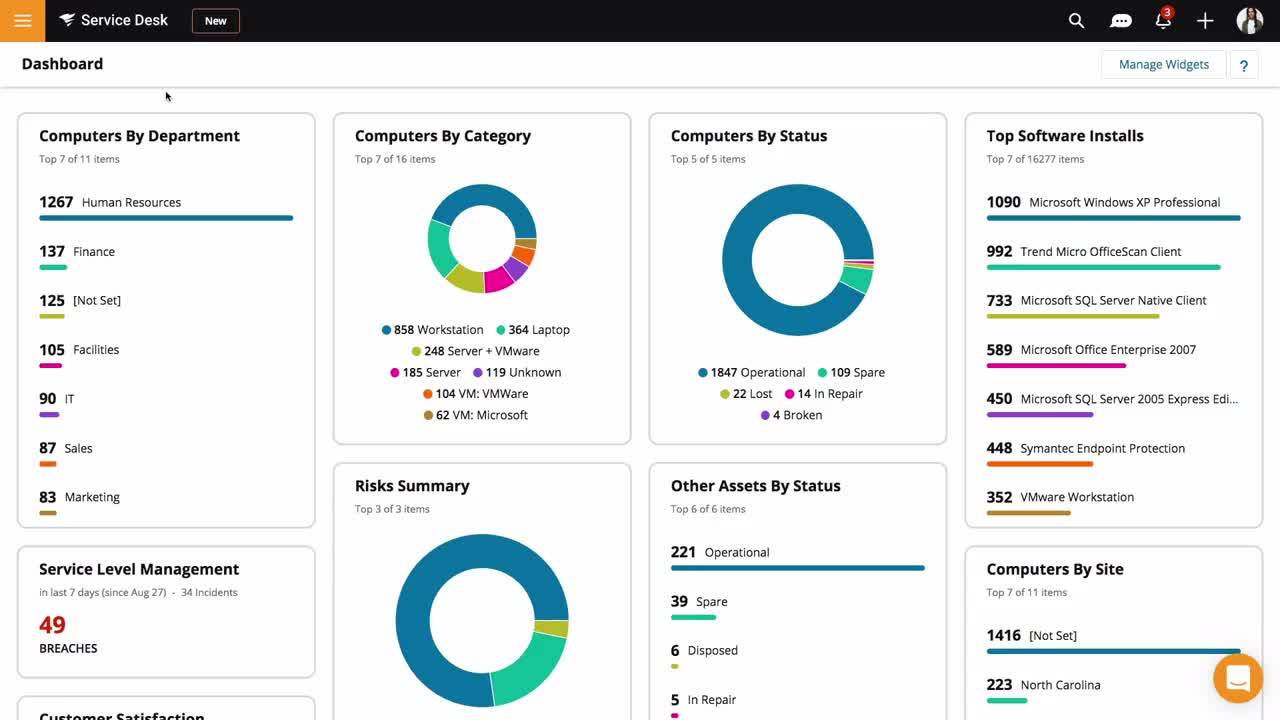
SolarWinds Service Desk has a fully integrated IT asset management software that offers powerful tools and capabilities in a single, web- based platform. Track your organization’s hardware and software inventory, including computers, servers, laptops, mobile devices, networking equipment, and virtually any other technology asset.
IT asset management (ITAM) is the process of cataloging, tracking, and maintaining an organization’s technology assets. IT asset management (sometimes known as information technology asset management) combines the ability to track and analyze the financial and contractual pieces against actual inventory to drive service success with a better understanding of how IT assets support the business and users. As an integral solution to the success of an organization, assets can include tangible, physical assets like hardware and servers, or intangible assets like software, purchase orders, and contracts.
IT asset management gives you the framework to document and manage the lifecycle of each IT asset from when it's first used to retirement of the asset, and the moves in between. Without IT asset management, recording the history of an asset would involve manually filling in spreadsheets each time an incident occurs, or new user takes over the asset. This can be daunting, time-consuming, and overwhelming when assessing incidents or performing root-cause analysis. An asset management software allows you to easily align your hardware and software inventory, asset owners and assignments, and location information in one place.
ITIL and asset management is a partnership ensuring you’re planning and managing the relationships between your IT assets and service tickets or requests. The ITIL framework is a set of best practices providing the foundation for better IT service management (ITSM). Incorporating the best practices of ITIL gives you the ability to manage your IT assets in real time with a full understanding of how incidents, problems, changes, and releases impact your assets through an integrated service desk. IT asset management solutions coupled with ITIL best practices reduce business risk by alerting IT of potential software security problems and threats.
The goals of ITIL and asset management software include:
ITIL asset management allows for more effective incident and problem management, which can improve resolution rates and reduce resolution times. It also makes it easier to move, add, or change configurations by connecting service information to specific assets. A good asset management strategy makes it easier to track software licenses and warranties so that your business can avoid unnecessary repair charges or fines for breaching service level agreements (SLAs). This helps keep ITSM costs down.
IT asset management (ITAM) software allows businesses to:
The IT asset management software benefits greatly from being as automated as possible. Track and tag hundreds of different hardware properties, software titles, and user and location history from your Windows, iOS, and Chrome OS devices. Save time and keep records up to date in a single location by compiling vendor data, warranties, lease terms, and agreements. Expedite break-fixes and changes within service desk tickets by automatically capturing and gathering each asset’s incident history.
IT pros can get a better understanding of users’ self-service patterns and how much money is being spent on assets. The ideal asset management software is fully unified with your service desk software so you can:
Companies currently operating with asset management solutions not connected with their ITSM tool, make it nearly impossible to do proper Asset Lifecycle Management. It’s critical to ensure your service desk software fully integrates with an asset management solution and proactively addresses potential issues.
One of the best ways you can keep track of all your hardware, software, and infrastructure systems is by using a discovery tool as a part of your asset management solution. Discovery tools in IT allow for end-to-end tracking of assets once they’ve been identified. Two of the most popular ways to collect asset information are the use of agents and, well, not using them, or agentless discovery tools.
One of the biggest benefits of agents is their ability to track laptops and other mobile devices. Asset management software using agents requires little infrastructure to set up as agents are simply installed on the device and can be tracked anywhere if they can connect to the internet. Although powerful, not all devices allow for agent installation. Agentless software does have an advantage on devices, such as routers and switches. So, if you’re looking to track such items, you’ll have to go a more manual route in your IT asset management strategy.
Since agent-based asset management software can be installed directly, the inventory information they collect is particularly precise because of their ability to capture certain data they wouldn’t be able to do otherwise. But while more data can be collected with agent-based, agentless data collection is still necessary.
The SolarWinds Discovery allows IT pros to relate new incidents to impacted devices. Having and creating a link to your infrastructure's assets helps streamline how your team communicates and works on organizational issues.