- Events
-
Partners
- Government
- Customer Portal
- Contact Us
- Contact Sales
-
English
DDoS attacks are performed by botnets, which infiltrate systems around the world. A botnet of a few hosts is relatively harmless, but a botnet comprised of thousands of machines represents a very powerful force capable of bringing down targeted organizations.
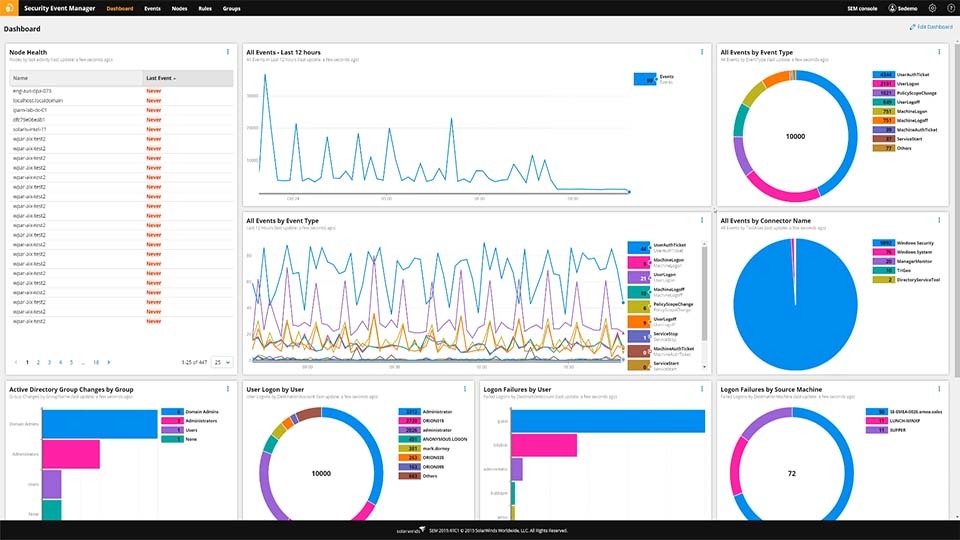
SolarWinds Security Event Manager (SEM) is built to leverage community-sourced lists of known bad actors to more easily identify interactions with potential command and control servers. This is accomplished by consolidating, normalizing, and reviewing logs from a wide range of sources, including IDS/IPS, firewalls, servers, authentication services, and workstations.
Botnets work by overwhelming legitimate online services to the extent that the online service can't handle the volume of activity and is effectively offline for the duration of the attack. A botnet can lie dormant until it receives instructions from the command and control servers.
SEM is designed with automated responses that can range from sending an alert, to blocking an IP, to actually shutting down an account. These options are easily configurable using checkboxes and do not require extensive custom scripts, helping ensure suspicious system activity doesn’t go unnoticed.
Logs and events captured by SolarWinds SEM are built to be encrypted, compressed, and recorded in an unalterable read-only format. This repository of logs represents a single source of truth that can be leveraged in post breach investigations and DDoS mitigation.
Searches in SEM are designed to be easily customized to filter for specific timeframes, specific accounts or IPs, or combinations of parameters. With a simple drag-and-drop UI leveraging simple Boolean logic, you can easily build queries to search in SEM without the need to use grep or regex.
A distributed denial-of-service (DDoS) attack is a type of cyberattack that uses the distributed power of many compromised machines to flood the target system with requests, overwhelming the system and preventing it from functioning. DDoS attacks are a complex form of denial-of-service (DoS) attacks, which only come from one source.
When a DDoS attack hits your server, a variety of malware programs is designed to overwhelm your server’s capacity to function, which can lead to partial or total shutdown of operations as these viruses and malware flood your network from multiple directions.
All DDoS attacks share the same strategy of multiple server-induced cyberattacks, but DDoS attacks can take a variety of forms. Common DDoS attacks include:
Early DDoS detection is critical for businesses because it can help protect the functioning and security of a network. Networks without a robust DDoS defense strategy may have trouble defending against the wide range of DDoS attacks, which can be difficult to trace.
Some DDoS attacks are sophisticated enough to successfully shut down large servers. Companies have lost web traffic and customer confidence due to DDoS attacks that entirely disabled their networks.
DDoS attacks are constantly evolving, and a well-defended server should employ the most cutting-edge defenses to protect against cyberattacks. Diagnosis tools are an important factor in DDoS detection, but they should not be your only tool—DDoS attacks can be difficult to extract once they have infected the network, so a strong anti-DDoS architecture should include preventative software built to trigger alerts and provide helpful diagnostics that inform when potential threats are identified.
DDoS malware is in a constant state of innovation, so DDoS detection tools must remain updated to identify the newest threat formats and addresses.
DDoS detection tools are designed to offer features that work to provide a united defense of your network’s security by tracking event logs of devices on the network to identify and trigger alerts if certain thresholds are met. DDoS detection tools like SolarWinds SEM can offer out-of-the-box correlation rules related to internet control message protocol (ICMP) as well as the ability to generate comprehensive reports to support in-depth threat diagnosis.
SolarWinds Security Event Manager uses a multilayered approach to DDoS detection. SEM is widely known for its SIEM log monitoring, but it is also equipped with extensive capabilities for anti-malware threat detection and blocking.
SolarWinds SEM is designed to detect exterior threats like DDoS attacks by collecting, normalizing, and correlating logs from across your system to provide deeper visibility and more easily catch patterns that could signal an attack. If a threat is detected, SEM can alert admins as well as deploy automatic responses to block activity and sever connections as needed.
SolarWinds SEM is also built to compare log events against an automatically-updated Threat Intelligence Feed to help detect DDoS attacks, as well as other forms of malware, viruses, and spam.
A distributed denial-of-service (DDoS) attack is a type of cyberattack that uses the distributed power of many compromised machines to flood the target system with requests, overwhelming the system and preventing it from functioning. DDoS attacks are a complex form of denial-of-service (DoS) attacks, which only come from one source.
When a DDoS attack hits your server, a variety of malware programs is designed to overwhelm your server’s capacity to function, which can lead to partial or total shutdown of operations as these viruses and malware flood your network from multiple directions.
All DDoS attacks share the same strategy of multiple server-induced cyberattacks, but DDoS attacks can take a variety of forms. Common DDoS attacks include:
Early DDoS detection is critical for businesses because it can help protect the functioning and security of a network. Networks without a robust DDoS defense strategy may have trouble defending against the wide range of DDoS attacks, which can be difficult to trace.
Some DDoS attacks are sophisticated enough to successfully shut down large servers. Companies have lost web traffic and customer confidence due to DDoS attacks that entirely disabled their networks.
DDoS attacks are constantly evolving, and a well-defended server should employ the most cutting-edge defenses to protect against cyberattacks. Diagnosis tools are an important factor in DDoS detection, but they should not be your only tool—DDoS attacks can be difficult to extract once they have infected the network, so a strong anti-DDoS architecture should include preventative software built to trigger alerts and provide helpful diagnostics that inform when potential threats are identified.
DDoS malware is in a constant state of innovation, so DDoS detection tools must remain updated to identify the newest threat formats and addresses.
DDoS detection tools are designed to offer features that work to provide a united defense of your network’s security by tracking event logs of devices on the network to identify and trigger alerts if certain thresholds are met. DDoS detection tools like SolarWinds SEM can offer out-of-the-box correlation rules related to internet control message protocol (ICMP) as well as the ability to generate comprehensive reports to support in-depth threat diagnosis.
SolarWinds Security Event Manager uses a multilayered approach to DDoS detection. SEM is widely known for its SIEM log monitoring, but it is also equipped with extensive capabilities for anti-malware threat detection and blocking.
SolarWinds SEM is designed to detect exterior threats like DDoS attacks by collecting, normalizing, and correlating logs from across your system to provide deeper visibility and more easily catch patterns that could signal an attack. If a threat is detected, SEM can alert admins as well as deploy automatic responses to block activity and sever connections as needed.
SolarWinds SEM is also built to compare log events against an automatically-updated Threat Intelligence Feed to help detect DDoS attacks, as well as other forms of malware, viruses, and spam.
Security Event Manager
Detect malicious activity between command and control servers and botnets using a list of community-sourced bad actors.
Respond in real time to suspicious activity or communications.
Determine the full extent of compromised security using integrated forensic tools.