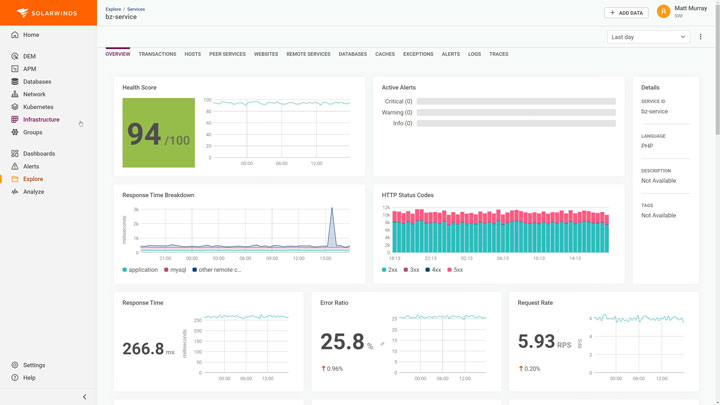
SolarWinds Observability Unify and extend visibility across the entire technology stack supporting your modern and custom web applications to help ensure key business services meet service level objectives and deliver optimal user experience.

Starts at $5.00
Complete observability from a leader in digital experience monitoring

SolarWinds Observability delivers unified and comprehensive visibility for cloud-native, custom web applications to help ensure optimal service levels and user satisfaction with key business services.


Observability Module Final Horizontal Option

Eliminate Tool Sprawl and gain comprehensive, single-pane-of-glass visibility with actionable intelligence

Accelerate issue resolution with built-in intelligence and actionable insights driven by data from across the environment

Reduce alert fatigue with AIOps, machine learning (ML), and a customized metrics -powered solution designed to automatically prioritize and surface real problems

Accelerate cloud modernization with cloud-native, multi-tenant observability that seamlessly integrates with SolarWinds Hybrid Cloud Observability to deliver a unified view across multi-cloud, hybrid, and on-premises environments

Built-in intelligence
AI and ML-based technologies automatically prioritize and surface real problems.
Comprehensive visibility
Unified data from across the environment with service relationship views, dependency maps, and multi-level drill-downs.
Easy to use
Quick to install, auto-instrumented, and easy to expand with support for open-source technologies.
Maximum flexibility
A unified platform with modular options designed to scale seamlessly as your needs grow.
Cloud-native
Designed for multi-cloud environments with support for open-source frameworks, cloud-native technologies, and third-party integrations.
Integrates with Hybrid Cloud Observability
Delivers a unified view across multi-cloud, hybrid, and on-premises environments.
Offerings
Designed for Maximum Flexibility
SolarWinds Observability is designed to provide customers with maximum flexibility and choice. It’s a unified platform offering with discrete capabilities so you can scale seamlessly as your needs grow.
  • Application Observability
  • Infrastructure Observability
  • Log Observability
  • Database Observability
  • Digital Experience Observability
  • Network Observability
  • Application Observability

    Comprehensive application observability goes beyond basic metrics, traces, logs offerings. It combines application performance metrics with distributed tracing and leverages log monitoring capabilities along with AIOps-driven notifications—and supports cloud-native open-source frameworks and third-party integrations. Application observability helps ensure the availability and performance of cloud-native custom applications and microservices. With application observability you can:

    • Eliminate tool sprawl with a single, fully integrated, full-stack observability offering spanning metrics, traces, and logs, to provide a single interface into every layer of cloud applications.
    • Reduce alert fatigue with AIOps-enhanced alerts, along with ML-powered baselining and customized metrics to automatically prioritize and surface real issues with a single view of thresholds exceeded as well as alert integration with major notification providers.
    • Manage performance proactively with advanced artificial intelligence (AI)-powered analytics designed to help evaluate complex performance metrics in real time.
    • Identify performance bottlenecks with powerful troubleshooting capabilities, such as distributed waterfall traces, exception tracking, and live code profiling to identify hotspots and pinpoint the cause of performance issues​.
    • Easy setup with a cloud-native solution designed for complex multi-cloud environments and built-in support for open-source frameworks and third-party integrations​.
    • Simplify management of complex modern applications with a holistic view of health and performance status across applications and their underlying components.

  • Infrastructure Observability

    Infrastructure observability helps ensures the health and performance of cloud-based resources, including VMs, storage, hosts, containers, and serverless and cloud service providers. Integration with AI-powered analytics and application and log observability combine to deliver context-rich intelligence to help you proactively identify and resolve performance issues. With infrastructure observability, you can:

    • Deliver data-driven insights. AI proactively monitors health and performance across cloud resources including hosts, containers, serverless environments, and infrastructure as a service-provided resources to enable proactive performance tuning and issue resolution.
    • Break down data silos. Aggregation of performance and health data across the cloud stack, entity grouping, and deep integration with log and metric data provides context to performance data and simplifies issue identification and resolution.
    • Scale seamlessly. Wide support for cloud-native and open frameworks, as well as third-party integrations delivers easy instrumentation. Auto-discovery and AI-enabled baselines and metrics provide dynamic infrastructure observability.
    • Correlate infrastructure in context with entities for databases, applications, websites, and more for quick and accurate troubleshooting​.
    • Monitor Kubernetes health with cluster, node, pod, and container details and out-of-the-box performance metrics.
    • Simplify management with holistic monitoring of servers, virtual hosts, and containers via native support for the OpenTelemetry Linux agent and dozens of AWS and Azure services.

  • Log Observability

    Log observability provides scalable, full-stack, multi-source log management, combining wide support, powerful search, AI-driven analytics, and built-in integration with application and infrastructure observability to deliver context-rich intelligence to help teams troubleshoot smarter and faster.

    • Provide context to event data. AI-driven insights via event aggregation and ML-powered analysis of log data across the entire cloud applications, services, and infrastructure stack.
    • Spend less time troubleshooting. Real-time log tailing and intuitive search across all log data helps accelerate root cause identification and reduce time spent troubleshooting, so teams have more time to innovate.
    • Leverage cloud-native frameworks. Easy setup with wide support for cloud-native and open-source frameworks, as well as third party integrations, lets teams use familiar tools for faster time to value.
    • Simplify log management with full-stack, multi-source log aggregation and a single search bar across all event data.
    • Manage risk with log archiving to ensure the availability of log data for forensic analysis and compliance reporting​.

  • Database Observability

    Database observability provides deep performance monitoring to diagnose and analyze issues, using sophisticated root cause analysis. Get comprehensive visibility into your database instances to help increase system performance and team efficiency while helping ensure infrastructure cost savings.

    ML-based AIOps and health scores based on golden metrics quickly highlight issues. Get full-stack observability by correlating database metrics with the application performance, distributed tracing, and log monitoring capabilities of SolarWinds Observability.

    Database observability simplifies the complexity of managing multi-vendor environments by providing support for databases such as MySQL, PostgreSQL, Microsoft SQL Server, AWS Aurora (PostgreSQL, MySQL), AWS RDS (PostgreSQL, MySQL), MongoDB, MongoDB Atlas, and Redis, so you can:

    • Ship better code. See query responses before and after a deployment event. Examine query details and performance, including samples and execution plans. Compare the performance of your top queries over time.
    • Troubleshoot and diagnose outages. Correlate query response or behavior to system metrics to understand impacts. Isolate unusual behavior and potential contributing factors within the database.
    • Understand database health. Track metrics and watch for trends with health summaries for databases and systems. Get recommendations based on best practices. Explore and examine performance outliers.
    • Simplify performance management with full-stack tracing and built-in intelligence designed to identify anomalies​.

  • Digital Experience Observability

    Digital experience observability enables DevOps teams to optimize the customer experience of web applications. Granular, real-time performance data, combined with AI-powered analytics, delivers deep insights into application performance impacts on the end user experience. Armed with this intelligence, DevOps team can experience the application the way the customer does—and make better design and implementation choices.

    • Optimize performance. Identify emerging performance issues with real-time metrics, including page speed, load time, and response speed.
    • Validate improvements. Test and optimize web elements using synthetic transaction queries to fine-tune critical web flows.
    • Spot usage trends. Use global sensors to track performance and filter performance data by geography, device, and browser.
    • Simplify monitoring with artificial intelligence (AI)-powered health scores, uptime status, and active alerts by website—in a single dashboard view.
    • Manage performance proactively for standard websites and single-page applications with real-time performance metrics, APEX satisfaction scores, and real user monitoring​.
    • Get started quickly with automated wizards designed to guide you through website setup, synthetic checks, and real user monitoring​.

  • Network Observability

    Network observability helps enable troubleshooting of the availability, health, and performance of on-premises networks and end-to-end connections to public cloud networks through the collection and analysis of diverse network metrics and logs. With network observability, organizations can more easily understand and visualize the overall picture of how the network is impacting the services and experiences depending on it. With network observability, you can:

    • Get a holistic end-to-end view of network paths, including the on-premises network and connections to the cloud provider’s infrastructure. This helps provide complete visibility into the network resources underpinning services, thereby reducing blind spots associated with traditional network tools and enabling more accurate and accelerated troubleshooting.
    • Eliminate tool sprawl. Network observability provides broad visibility across multi-vendor and multi-cloud networks by aggregating a comprehensive set of metrics into a single-pane-of-glass network view and enabling insights into how any impact on end users and business services may be correlated to network issues historically or in real time. This holistic approach also helps reduce the inefficiencies and risk often associated with piecing together information from multiple disparate tools.
    • Scale with efficiency. Network Observability helps reduce the overhead and inaccuracy associated with static thresholds through AIOps-enabled pattern recognition and anomaly detection allowing network operations teams to be more productive. It also provides insights into correlated alerts and events to accelerate root cause analysis. This approach should also help to scale the Network with a leaner management team.

Application Observability

Comprehensive application observability goes beyond basic metrics, traces, logs offerings. It combines application performance metrics with distributed tracing and leverages log monitoring capabilities along with AIOps-driven notifications—and supports cloud-native open-source frameworks and third-party integrations. Application observability helps ensure the availability and performance of cloud-native custom applications and microservices. With application observability you can:

  • Eliminate tool sprawl with a single, fully integrated, full-stack observability offering spanning metrics, traces, and logs, to provide a single interface into every layer of cloud applications.
  • Reduce alert fatigue with AIOps-enhanced alerts, along with ML-powered baselining and customized metrics to automatically prioritize and surface real issues with a single view of thresholds exceeded as well as alert integration with major notification providers.
  • Manage performance proactively with advanced artificial intelligence (AI)-powered analytics designed to help evaluate complex performance metrics in real time.
  • Identify performance bottlenecks with powerful troubleshooting capabilities, such as distributed waterfall traces, exception tracking, and live code profiling to identify hotspots and pinpoint the cause of performance issues​.
  • Easy setup with a cloud-native solution designed for complex multi-cloud environments and built-in support for open-source frameworks and third-party integrations​.
  • Simplify management of complex modern applications with a holistic view of health and performance status across applications and their underlying components.

Close
Infrastructure Observability

Infrastructure observability helps ensures the health and performance of cloud-based resources, including VMs, storage, hosts, containers, and serverless and cloud service providers. Integration with AI-powered analytics and application and log observability combine to deliver context-rich intelligence to help you proactively identify and resolve performance issues. With infrastructure observability, you can:

  • Deliver data-driven insights. AI proactively monitors health and performance across cloud resources including hosts, containers, serverless environments, and infrastructure as a service-provided resources to enable proactive performance tuning and issue resolution.
  • Break down data silos. Aggregation of performance and health data across the cloud stack, entity grouping, and deep integration with log and metric data provides context to performance data and simplifies issue identification and resolution.
  • Scale seamlessly. Wide support for cloud-native and open frameworks, as well as third-party integrations delivers easy instrumentation. Auto-discovery and AI-enabled baselines and metrics provide dynamic infrastructure observability.
  • Correlate infrastructure in context with entities for databases, applications, websites, and more for quick and accurate troubleshooting​.
  • Monitor Kubernetes health with cluster, node, pod, and container details and out-of-the-box performance metrics.
  • Simplify management with holistic monitoring of servers, virtual hosts, and containers via native support for the OpenTelemetry Linux agent and dozens of AWS and Azure services.

Close
Log Observability

Log observability provides scalable, full-stack, multi-source log management, combining wide support, powerful search, AI-driven analytics, and built-in integration with application and infrastructure observability to deliver context-rich intelligence to help teams troubleshoot smarter and faster.

  • Provide context to event data. AI-driven insights via event aggregation and ML-powered analysis of log data across the entire cloud applications, services, and infrastructure stack.
  • Spend less time troubleshooting. Real-time log tailing and intuitive search across all log data helps accelerate root cause identification and reduce time spent troubleshooting, so teams have more time to innovate.
  • Leverage cloud-native frameworks. Easy setup with wide support for cloud-native and open-source frameworks, as well as third party integrations, lets teams use familiar tools for faster time to value.
  • Simplify log management with full-stack, multi-source log aggregation and a single search bar across all event data.
  • Manage risk with log archiving to ensure the availability of log data for forensic analysis and compliance reporting​.

Close
Database Observability

Database observability provides deep performance monitoring to diagnose and analyze issues, using sophisticated root cause analysis. Get comprehensive visibility into your database instances to help increase system performance and team efficiency while helping ensure infrastructure cost savings.

ML-based AIOps and health scores based on golden metrics quickly highlight issues. Get full-stack observability by correlating database metrics with the application performance, distributed tracing, and log monitoring capabilities of SolarWinds Observability.

Database observability simplifies the complexity of managing multi-vendor environments by providing support for databases such as MySQL, PostgreSQL, Microsoft SQL Server, AWS Aurora (PostgreSQL, MySQL), AWS RDS (PostgreSQL, MySQL), MongoDB, MongoDB Atlas, and Redis, so you can:

  • Ship better code. See query responses before and after a deployment event. Examine query details and performance, including samples and execution plans. Compare the performance of your top queries over time.
  • Troubleshoot and diagnose outages. Correlate query response or behavior to system metrics to understand impacts. Isolate unusual behavior and potential contributing factors within the database.
  • Understand database health. Track metrics and watch for trends with health summaries for databases and systems. Get recommendations based on best practices. Explore and examine performance outliers.
  • Simplify performance management with full-stack tracing and built-in intelligence designed to identify anomalies​.

Close
Digital Experience Observability

Digital experience observability enables DevOps teams to optimize the customer experience of web applications. Granular, real-time performance data, combined with AI-powered analytics, delivers deep insights into application performance impacts on the end user experience. Armed with this intelligence, DevOps team can experience the application the way the customer does—and make better design and implementation choices.

  • Optimize performance. Identify emerging performance issues with real-time metrics, including page speed, load time, and response speed.
  • Validate improvements. Test and optimize web elements using synthetic transaction queries to fine-tune critical web flows.
  • Spot usage trends. Use global sensors to track performance and filter performance data by geography, device, and browser.
  • Simplify monitoring with artificial intelligence (AI)-powered health scores, uptime status, and active alerts by website—in a single dashboard view.
  • Manage performance proactively for standard websites and single-page applications with real-time performance metrics, APEX satisfaction scores, and real user monitoring​.
  • Get started quickly with automated wizards designed to guide you through website setup, synthetic checks, and real user monitoring​.

Close
Network Observability

Network observability helps enable troubleshooting of the availability, health, and performance of on-premises networks and end-to-end connections to public cloud networks through the collection and analysis of diverse network metrics and logs. With network observability, organizations can more easily understand and visualize the overall picture of how the network is impacting the services and experiences depending on it. With network observability, you can:

  • Get a holistic end-to-end view of network paths, including the on-premises network and connections to the cloud provider’s infrastructure. This helps provide complete visibility into the network resources underpinning services, thereby reducing blind spots associated with traditional network tools and enabling more accurate and accelerated troubleshooting.
  • Eliminate tool sprawl. Network observability provides broad visibility across multi-vendor and multi-cloud networks by aggregating a comprehensive set of metrics into a single-pane-of-glass network view and enabling insights into how any impact on end users and business services may be correlated to network issues historically or in real time. This holistic approach also helps reduce the inefficiencies and risk often associated with piecing together information from multiple disparate tools.
  • Scale with efficiency. Network Observability helps reduce the overhead and inaccuracy associated with static thresholds through AIOps-enabled pattern recognition and anomaly detection allowing network operations teams to be more productive. It also provides insights into correlated alerts and events to accelerate root cause analysis. This approach should also help to scale the Network with a leaner management team.

Close
Pricing
Application Observability
Starts at:
Real-time application metrics, distributed tracing, & code profiling
Network and Infrastructure Observability
Starts at:
Network devices and hosts (1:1), cloud services (3:1), containers (10:1)
Log Observability
Starts at:
Scalable, full stack, multi-source log management
Database Observability
Starts at:
Deep database performance analysis with root cause diagnostics
Digital Experience Observability - Synthetic
Starts at:
Synthetic Monitoring - Availability and performance insights
Digital Experience Observability - Real User Monitoring
Starts at:
Real user monitoring – gain insights into how actual users experience your websites

*USD per month, billed annually

SolarWinds Observability built for DevOps

Let’s talk it over.
Contact our team. Anytime.
{#Contact Phone#}
{{STATIC CONTENT}}
{{CAPTION_TITLE}}

{{CAPTION_CONTENT}}

{{TITLE}}