- Events
-
Partners
- Government
- Customer Portal
- Contact Us
- Contact Sales
-
English
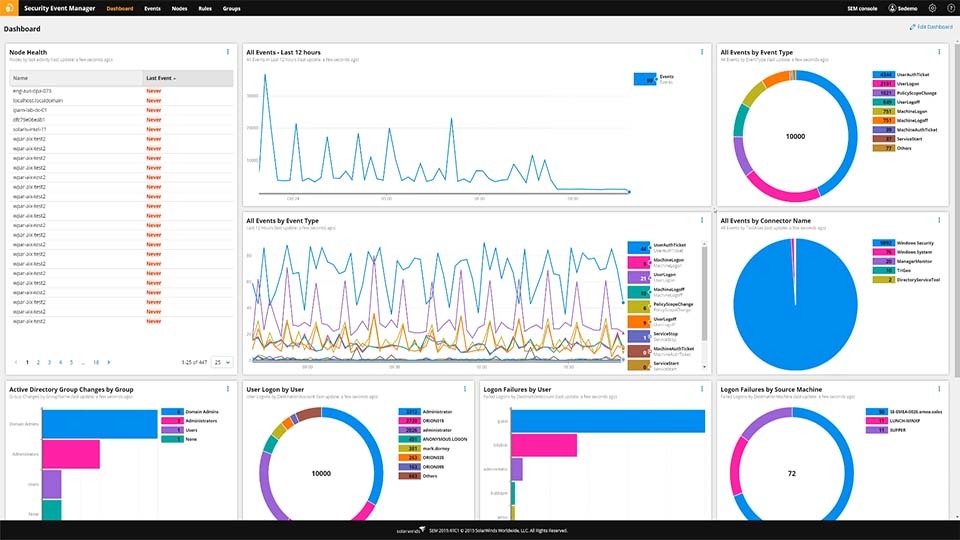
SolarWinds Security Event Manager serves as a powerful security information management tool that is built to identify potential threats in current and historical logs. SEM monitors your centrally stored log file data for suspicious anomalies, including unauthorized modifications made to files or issues with user permissions and registry settings. SEM is designed to compare detected threats against an updated database of known threats, like bad IPs, so you’re working from up to date security information.
Paired with real-time activity monitoring and an alert notification system that you can tailor to suit the needs of your team and organization, SEM provides key capabilities of SIM and security event management tools.
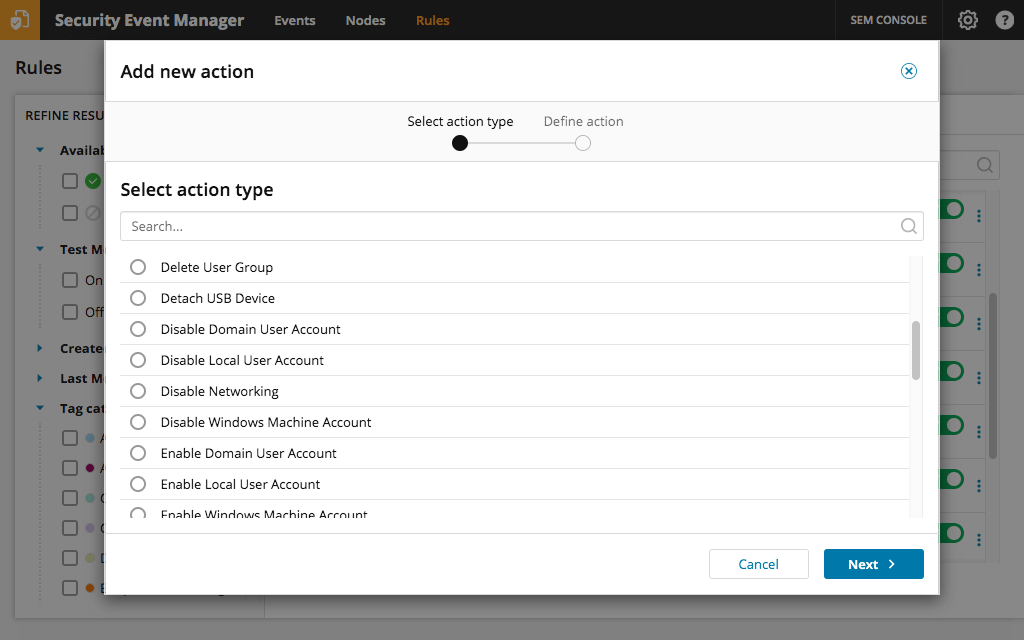
Security Event Manager provides powerful cyber risk management tools to help you defend your network against potential threats. Admins can use custom event correlation tools to specify which incidents and data patterns should trigger automated responses. SEM can quickly perform a range of functions—it can block IP addresses, kill malicious applications, or lock out users—automatically. Minimizing your response time can reduce the impact of cyberattacks and give admins time to respond more thoroughly to the threat.
Due to the increase in high-profile data breaches, more and more data security standards are becoming legal requirements. The SolarWinds security information management tool features comprehensive reporting that is both customizable and easy to use for identifying data trends and network behavior. A key component of security information management is utilizing historical log data to run forensics and assess performance. SEM is designed to make it easy to run reports on historical or current log data, as well as schedule automated reports to send to stakeholders. As a log management and IT compliance reporting tool, SEM supports your efforts to comply with data security standards like HIPAA, PCI DSS, SOX, and more.
Get More on Security Information Management
Do you find yourself asking…
Security Information Management (SIM) is a series of processes through which data from computer event and activity logs is compiled, monitored, and analyzed. SIM refers specifically to the part of this process having to do with historical log analysis and reporting, while Security Event Management (SEM) refers to the real-time activities involved in gathering and analyzing logs. Together, these processes form a complete Security Information and Event Management (SIEM) solution.
IT device logs are the raw material that log management and SIM cyber security applications use when performing analysis and are used by administrators to troubleshoot problems or potential issues identified by the log analysis. Security information management tools also perform information security compliance risk analysis on these log files, aggregating the data, presenting findings, and correlating in one or more GUI dashboards to allow administrators to better act upon the analysis.
Many SIEM-integrated security information management systems include alerting tools that automatically inform administrators if particularly suspicious or malicious behavior is detected in the log files. Typically, SIM tools allow admins to run reports to initiate troubleshooting or support regulatory compliance management.
Security information management systems can also automate log analysis and reporting processes for ease of use by compiling event logs from a number of different devices related to network and device security: firewalls, antivirus applications, routers, proxy servers, as well as intrusion detection and prevention systems. This is necessary to obtain a broad and comprehensive view of activity across the network. Security information management systems collect this vast amount of data and simplify it, allowing IT administrators to more easily do the work of information security risk management by investigating historical patterns of suspicious behavior, addressing or mitigating risk, and reporting on security status and results.
Security Information Management (SIM) refers to the collection and analysis of application and device log data that has been generated. Security Event Management (SEM) refers to the process of monitoring networks and devices in real time for activity and events that are signs of malicious or unauthorized behavior. SIM and SEM programs work well together—most comprehensive security management systems combine the functionality of SIM and SEM applications, creating what’s called an SIEM system, or Security Information and Event Management system. SIEM consolidates important security data from a range of sources and makes it accessible via one dashboard, which can allow for faster identification of patterns over time while also giving you up-to-the-moment information on activity.
Security information management supports the ability to respond to security threats faster and more efficiently. SIM systems let you access data pulled from multiple network sources via a single user interface. By compiling and correlating this log data, these systems help simplify much of the work involving identifying patterns of unauthorized user behavior and suspicious trends. This provides IT administrators with the information and evidence needed to resolve detected threats or intrusions more swiftly than if they were doing the analysis manually.
A Security Information Management (SIM) system includes tools to help optimize your time and resources to more efficiently identify and resolve cyberthreats. By collecting log files in a central location, SIMs are designed to make it easier for administrators to access and analyze a single source of truth, which also removes the need to track down files from different departments that may be running on different networks or operating systems.
While tools with security event management capabilities provide near real-time analysis of network activity, allowing you to rapidly respond to threats and resolve issues, the information management component of SIM offers insights into trends and patterns over time that may not be easily noticed. By combining these two different security functions, a SIEM application like SolarWinds Security Event Manager is built to provide faster and more detailed analysis. By automating the log storage and analysis processes, they can also help your company meet compliance requirements. SIM may include detection systems that can automatically shut down intrusive functions. The centralized aspect of SIEM solutions also means that compliance reporting is a much more streamlined process, and can be used to quickly determine whether your practices are in compliance with a variety of data security standards.
SolarWinds Security Event Manager is a robust SIEM tool that works to maintain file integrity by monitoring for modifications made to log files, deleted log files, or unauthorized changes made to user permissions, files, or registry settings, as these can often be an indication of malicious behavior. A custom alert system allows you to adjust the conditions and thresholds at which you and your team want to receive notifications.
Lags in computing are never good, and a lag in security processes can be costly. Security Event Manager is built to give you control over your network processes if a threat is detected, including the ability to automate responses—from blocking IP addresses or USB devices to killing applications or disabling accounts—to reduce response time. Being able to demonstrate that you were able to quickly prevent or mitigate the harm caused by security events can help save your organization from fines or legal action, and also helps protect your reputation. Security Event Manager is built to provide reporting designed to help organizations demonstrate necessary compliance requirements, including HIPAA, PCI DSS, SOX, and others.
Security Information Management (SIM) is a series of processes through which data from computer event and activity logs is compiled, monitored, and analyzed. SIM refers specifically to the part of this process having to do with historical log analysis and reporting, while Security Event Management (SEM) refers to the real-time activities involved in gathering and analyzing logs. Together, these processes form a complete Security Information and Event Management (SIEM) solution.
IT device logs are the raw material that log management and SIM cyber security applications use when performing analysis and are used by administrators to troubleshoot problems or potential issues identified by the log analysis. Security information management tools also perform information security compliance risk analysis on these log files, aggregating the data, presenting findings, and correlating in one or more GUI dashboards to allow administrators to better act upon the analysis.
Many SIEM-integrated security information management systems include alerting tools that automatically inform administrators if particularly suspicious or malicious behavior is detected in the log files. Typically, SIM tools allow admins to run reports to initiate troubleshooting or support regulatory compliance management.
Security information management systems can also automate log analysis and reporting processes for ease of use by compiling event logs from a number of different devices related to network and device security: firewalls, antivirus applications, routers, proxy servers, as well as intrusion detection and prevention systems. This is necessary to obtain a broad and comprehensive view of activity across the network. Security information management systems collect this vast amount of data and simplify it, allowing IT administrators to more easily do the work of information security risk management by investigating historical patterns of suspicious behavior, addressing or mitigating risk, and reporting on security status and results.
Security Information Management (SIM) refers to the collection and analysis of application and device log data that has been generated. Security Event Management (SEM) refers to the process of monitoring networks and devices in real time for activity and events that are signs of malicious or unauthorized behavior. SIM and SEM programs work well together—most comprehensive security management systems combine the functionality of SIM and SEM applications, creating what’s called an SIEM system, or Security Information and Event Management system. SIEM consolidates important security data from a range of sources and makes it accessible via one dashboard, which can allow for faster identification of patterns over time while also giving you up-to-the-moment information on activity.
Security information management supports the ability to respond to security threats faster and more efficiently. SIM systems let you access data pulled from multiple network sources via a single user interface. By compiling and correlating this log data, these systems help simplify much of the work involving identifying patterns of unauthorized user behavior and suspicious trends. This provides IT administrators with the information and evidence needed to resolve detected threats or intrusions more swiftly than if they were doing the analysis manually.
A Security Information Management (SIM) system includes tools to help optimize your time and resources to more efficiently identify and resolve cyberthreats. By collecting log files in a central location, SIMs are designed to make it easier for administrators to access and analyze a single source of truth, which also removes the need to track down files from different departments that may be running on different networks or operating systems.
While tools with security event management capabilities provide near real-time analysis of network activity, allowing you to rapidly respond to threats and resolve issues, the information management component of SIM offers insights into trends and patterns over time that may not be easily noticed. By combining these two different security functions, a SIEM application like SolarWinds Security Event Manager is built to provide faster and more detailed analysis. By automating the log storage and analysis processes, they can also help your company meet compliance requirements. SIM may include detection systems that can automatically shut down intrusive functions. The centralized aspect of SIEM solutions also means that compliance reporting is a much more streamlined process, and can be used to quickly determine whether your practices are in compliance with a variety of data security standards.
SolarWinds Security Event Manager is a robust SIEM tool that works to maintain file integrity by monitoring for modifications made to log files, deleted log files, or unauthorized changes made to user permissions, files, or registry settings, as these can often be an indication of malicious behavior. A custom alert system allows you to adjust the conditions and thresholds at which you and your team want to receive notifications.
Lags in computing are never good, and a lag in security processes can be costly. Security Event Manager is built to give you control over your network processes if a threat is detected, including the ability to automate responses—from blocking IP addresses or USB devices to killing applications or disabling accounts—to reduce response time. Being able to demonstrate that you were able to quickly prevent or mitigate the harm caused by security events can help save your organization from fines or legal action, and also helps protect your reputation. Security Event Manager is built to provide reporting designed to help organizations demonstrate necessary compliance requirements, including HIPAA, PCI DSS, SOX, and others.
Security Event Manager
Stay on top of suspicious activity on your network with powerful monitoring tools.
Easily mitigate potential harm caused by detected threats.
More easily demonstrate security compliance with audit-ready reports.