- Events
-
Partners
- Government
- Customer Portal
- Contact Us
- Contact Sales
-
English
Today’s employees are mobile—they might work from home, from the beach, or from the airplane. On-the-go employees need a way to streamline ticket submission without limitations from their service providers. With SolarWinds® Service Desk, increased collaboration from one service provider to the next gives your employees flexibility. There’s no need for different incident management solutions for different departments. You can easily manage tickets submitted via email, phone calls, a service portal, mobile app, chat, email, phone calls, or even in person.
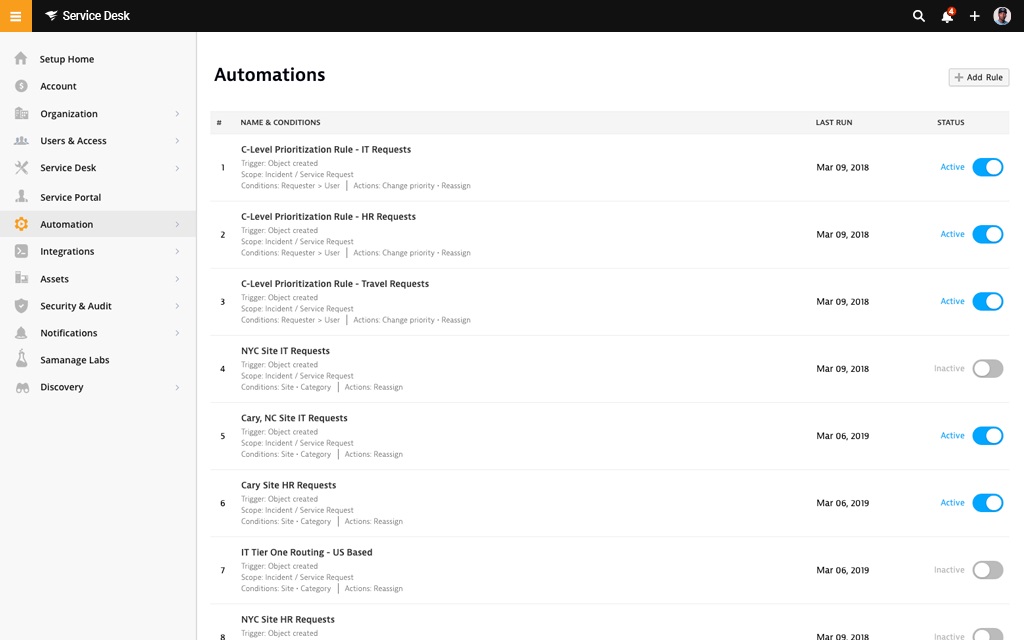
Your organization can operate much more quickly with a unified way to meet employee service demands. The right incident management solution gives your service and support teams automated rules to eliminate simple tasks, route tickets to the right people, and resolve incidents more quickly. The quicker you get your resources aligned, the faster a ticket is closed. Automated incident tracking software aims to give your business its time back, so you can focus on what really matters.
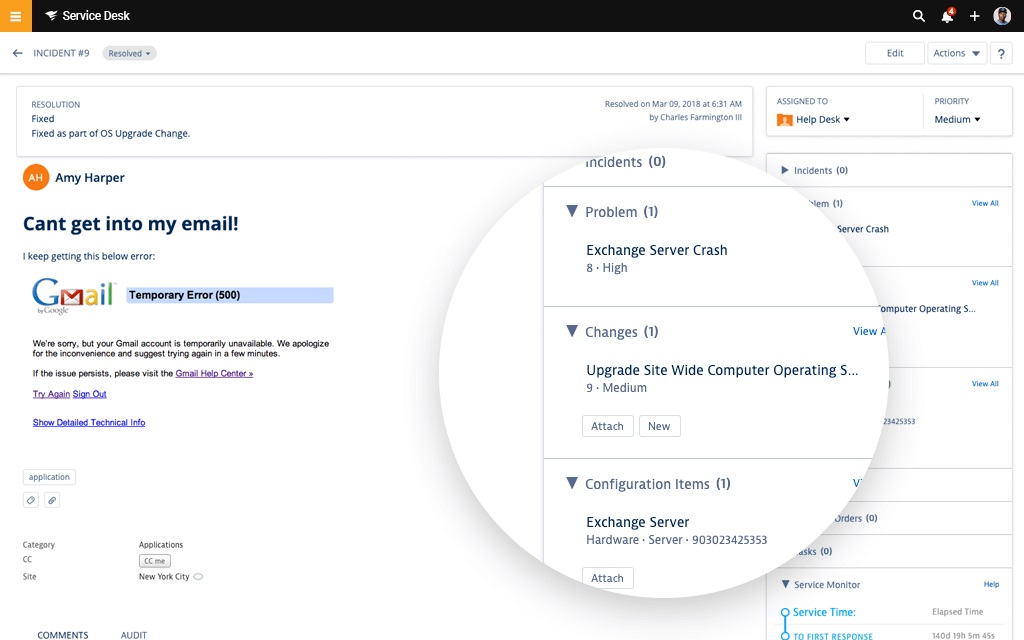
Since ITIL is a framework, the adoption of ITIL best practices vary from one organization to another. We help you adopt and support ITIL best practices by giving you the power to assess your employees’ needs. For both requesters and agents, incidents and impacted assets are matched with relevant solutions articles. And once your IT team has received a ticket, they can quickly fulfill employee needs by visualizing the full incident lifecycle while keeping ITIL best practices in mind by easily escalating incidents to a problem or associating them to an upcoming change.
We know you’re often short on time, so SolarWinds Service Desk uses artificial intelligence to increase your efficiency and productivity. You can accelerate incident resolution because we automatically recommend the right solution for a ticket. Moreover, you can easily consolidate resolution of tickets while escalating related incidents to a problem since we give you suggestions when an incident is similar to other open tickets. Ticket categorization and routing are also streamlined, since we help you select the best matching categories for inbound incidents.
Incident management in ITIL is a foundational part of an organization’s strategy for ensuring IT function and security. Proactive tools can’t always prevent system issues—so incident management is critical for when problems occur. With a centralized system for incident management, employees know where to go to get help and technicians gain a more organized way to diagnose and manage system issues.
ITIL, which originally stood for the Information Technology Infrastructure Library, is a standard industry framework for incident management, used by many major IT companies in their incident management software. ITIL operates using a uniform protocol, which is regularly updated to accommodate new technologies. If your incident management software is verified to follow ITIL protocol, you can rest assured standard incident management solutions are in place.
ITIL guidelines include incident management as a critical function for business IT. When something is amiss in your system, employees are often the first users to notice. Incident management helps to fix issues based on detailed complaints, or “tickets,” submitted by your employees. Once an employee has submitted a ticket alerting IT management of an incident, IT management must diagnose the incident and send it to the appropriate technician. The problem might be an issue with network functionality, CPU or storage capacity, memory, malware, or any number of other common IT issues affecting end users. With an organized system for ITIL incident management, a business can more quickly resolve a range of issues and help the employee get back to work with the IT tools they need.
Incident management aims to identify, diagnose, and fix problems across an organization’s IT infrastructure.
Incident management helps to ensure your business has the IT support it needs to function efficiently. Even when you have preventative measures in place, like data log security monitors and firewalls, various system issues like memory, capacity, or sophisticated cyberthreats might slip under your radar. When an employee experiences an issue, it will be necessary to deploy a tool to respond to an undetected problem. That’s where incident management comes in. IT incident management useful and can even be critical. It’s all too possible for an incident to escalate to a much more serious problem affecting security or functionality.
Another important function of incident management is its ability to maintain a foundation of trust in your business. When system errors prevent network functionality, your employees will be uneasy about the privacy and quality of their work environment. Even worse, customers who are unable to voice incident complaints are unlikely to trust your business, either. Trust in your business’ safety and reliability can depend on your ability to receive and fix incident tickets in a timely fashion.
An incident management system is a tool designed to help speed up and automate the incident management process. Incident management software can process tickets, escalate tickets to problems when necessary, and provide recommendations to IT managers when problems need solutions.
Incident management systems provide a necessary link between IT managers and employees. When your network users encounter an issue, you need an efficient channel to connect users with real, human IT managers in an organized way that won’t overwhelm managers of even the largest networks. Incident tracking software helps consolidate the ticket-to-problem process, so IT managers aren’t flooded with individual, ad-hoc questions in their inbox.
Incident management software can be an integral part of your incident management solution. IT incident management software helps automate incident management at each step of the process: identification, diagnosis, and solution. Effective incident management software can help identify issues by offering a quick and effective ticketing system, by diagnosing problems with creative solutions, and by providing recommendations to assist IT managers with fixes.
SolarWinds Service Desk offers a comprehensive incident management using the ITIL framework. Service Desk is a scalable solution, with the ability to support service management for organizations large and small.
To maximize the efficiency of the incident management process, Service Desk includes a unique employee service portal, which informs employees of common issues that might be mistaken as a more serious incident. If an employee is experiencing an issue that can be easily self-corrected, there’s no need to flood the incident management system with superfluous requests—they can simply refer to FAQs within the knowledge base.
As more incidents are processed through Service Desk, SolarWinds AI tools can constantly develop your existing knowledge into more accurate and sophisticated solutions. The longer you use Service Desk, the more precise the incident response solutions will become.
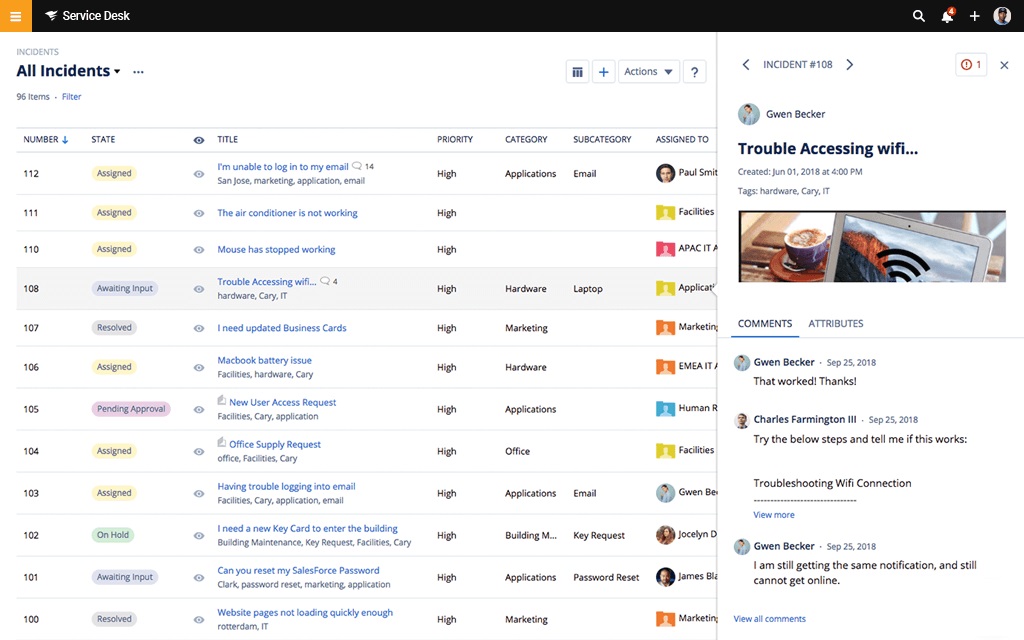
For IT managers, SolarWinds also employs an intuitive visual interface with customizable displays. Service Desk makes it easy to visualize the entire incident management process, from beginning to end.
Incident management in ITIL is a foundational part of an organization’s strategy for ensuring IT function and security. Proactive tools can’t always prevent system issues—so incident management is critical for when problems occur. With a centralized system for incident management, employees know where to go to get help and technicians gain a more organized way to diagnose and manage system issues.
ITIL, which originally stood for the Information Technology Infrastructure Library, is a standard industry framework for incident management, used by many major IT companies in their incident management software. ITIL operates using a uniform protocol, which is regularly updated to accommodate new technologies. If your incident management software is verified to follow ITIL protocol, you can rest assured standard incident management solutions are in place.
ITIL guidelines include incident management as a critical function for business IT. When something is amiss in your system, employees are often the first users to notice. Incident management helps to fix issues based on detailed complaints, or “tickets,” submitted by your employees. Once an employee has submitted a ticket alerting IT management of an incident, IT management must diagnose the incident and send it to the appropriate technician. The problem might be an issue with network functionality, CPU or storage capacity, memory, malware, or any number of other common IT issues affecting end users. With an organized system for ITIL incident management, a business can more quickly resolve a range of issues and help the employee get back to work with the IT tools they need.
Incident management aims to identify, diagnose, and fix problems across an organization’s IT infrastructure.
Incident management helps to ensure your business has the IT support it needs to function efficiently. Even when you have preventative measures in place, like data log security monitors and firewalls, various system issues like memory, capacity, or sophisticated cyberthreats might slip under your radar. When an employee experiences an issue, it will be necessary to deploy a tool to respond to an undetected problem. That’s where incident management comes in. IT incident management useful and can even be critical. It’s all too possible for an incident to escalate to a much more serious problem affecting security or functionality.
Another important function of incident management is its ability to maintain a foundation of trust in your business. When system errors prevent network functionality, your employees will be uneasy about the privacy and quality of their work environment. Even worse, customers who are unable to voice incident complaints are unlikely to trust your business, either. Trust in your business’ safety and reliability can depend on your ability to receive and fix incident tickets in a timely fashion.
An incident management system is a tool designed to help speed up and automate the incident management process. Incident management software can process tickets, escalate tickets to problems when necessary, and provide recommendations to IT managers when problems need solutions.
Incident management systems provide a necessary link between IT managers and employees. When your network users encounter an issue, you need an efficient channel to connect users with real, human IT managers in an organized way that won’t overwhelm managers of even the largest networks. Incident tracking software helps consolidate the ticket-to-problem process, so IT managers aren’t flooded with individual, ad-hoc questions in their inbox.
Incident management software can be an integral part of your incident management solution. IT incident management software helps automate incident management at each step of the process: identification, diagnosis, and solution. Effective incident management software can help identify issues by offering a quick and effective ticketing system, by diagnosing problems with creative solutions, and by providing recommendations to assist IT managers with fixes.
SolarWinds Service Desk offers a comprehensive incident management using the ITIL framework. Service Desk is a scalable solution, with the ability to support service management for organizations large and small.
To maximize the efficiency of the incident management process, Service Desk includes a unique employee service portal, which informs employees of common issues that might be mistaken as a more serious incident. If an employee is experiencing an issue that can be easily self-corrected, there’s no need to flood the incident management system with superfluous requests—they can simply refer to FAQs within the knowledge base.
As more incidents are processed through Service Desk, SolarWinds AI tools can constantly develop your existing knowledge into more accurate and sophisticated solutions. The longer you use Service Desk, the more precise the incident response solutions will become.
For IT managers, SolarWinds also employs an intuitive visual interface with customizable displays. Service Desk makes it easy to visualize the entire incident management process, from beginning to end.
Try Web Help Desk. It’s our affordable and safe Help Desk Ticketing and Asset Management Software.
Automate user service request management from ticket creation, assignment, routing, and escalation.
Use built-in reports (or create your own) to track ticket status, technician performance, and customer support needs.
Leverage a built-in help desk knowledge base to create and maintain KB articles and promote end-user self-service for common issues.