- Events
-
Partners
- Government
- Customer Portal
- Contact Us
- Contact Sales
-
English
A domain controller is a server designed to respond to security authentication requests within a network and verify users on their devices. When a user logs in to the network, system, or service—for example, Windows Active Directory (AD)—the domain controller is built to instantly authenticate and validate their credentials. This is traditionally in the form of a username, password, or an IP location. Then, the domain controller either denies or allows access depending on the validity of the user and their device.
Domain controllers are made to organize and secure all data necessary to determine and validate users, device names, and group policies. Usually, a domain controller will use a hierarchical organization system to arrange the information found within it, using a tree-like system to group users and protect them in similar ways. This helps keep groups of network elements safe from bad actors.
The domain controller for a given IT system lives on a single piece of hardware dedicated to performing authentication tasks across network machines, devices, and end users. These elements can also be known as clients. Using a single piece of hardware for your domain controller helps simplify the process of validating each individual user, especially in large networks composed of hundreds of client devices.
Domain controller monitoring is important to keeping your network’s devices, end users, and proprietary information safe from getting into the wrong hands. Your domain controller is filled with proprietary data including group policies, device names, and end-user information. This is why the domain controller is a common target during cyberattacks—a bad actor could steal and use domain controller data to cause massive damage.
It’s important to monitor a domain controller constantly because of its vulnerability, but also to discover slowdowns or failures as soon as they occur. Any related problems could severely impact end users and cause a slew of other issues. Continuous domain controller monitoring can enable you to troubleshoot domain controller problems the moment they’re discovered. This also enables you to check domain controller health and check domain replication moment-to-moment, so you can always have an up-to-date stream of domain controller diagnostics.
Understanding the current performance of your domain controller can help you check domain replication, optimize your domain controller’s functionality, and improve the security of the valuable data within your network. Domain controller monitoring can also enable you to look out for deviations within your network when it comes to current account activity, such as password change or reset attempts. The best way to check domain controller health is to use a domain controller monitoring tool.
Through effective domain controller monitoring, you can detect critical domain controller issues and anomalies earlier as you routinely check domain replication and performance. This can help you avoid serious problems such as account lockouts, security policy failures, data quality issues, and other overall complications with your domain controller.
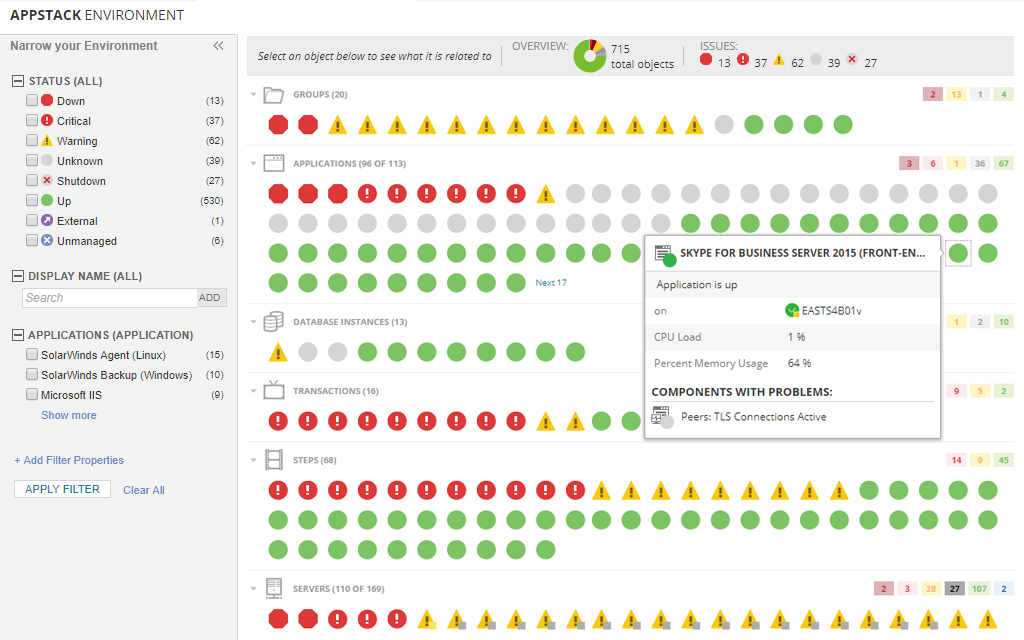
Domain control monitoring works in SolarWinds Server & Application Monitor (SAM) by using an application monitor template, which consists of a group of component monitors. SAM component monitors are designed to let you check domain controller health, check domain replication health, verify AD replication, and troubleshoot domain controller problems. This can help you understand your domain controller’s current performance and optimize functionality.
Instead of creating individual component monitors one by one, SAM can enable you to assign a prebuilt template to your domain controller. SAM enables you to customize and assign templates yourself, or you can enable SAM to assign templates to groups within your domain controller automatically.
As soon as you assign a SAM template to a domain controller, you can begin to troubleshoot domain controller issues. SAM component monitors can also help you check domain replication status and ensure the functionality of other operations. SAM is designed to offer a wide array of specified component monitors, including:
Along with using a template, SAM can enable you to add the AppInsight™ feature to monitor domain controller events and functionality. After adding AppInsight to your domain controller, SAM can enable you to customize the settings for each individual component monitor. In large environments, some of these settings could directly impact domain controller diagnostics and performance.
SAM can also enable you to limit the data AppInsight polls on domain controllers during monitoring. Through this, SAM can help reduce redundant data collection and improve performance, especially in bigger environments. SAM is built to support the monitoring of up to 200 domain controllers, making this tool an excellent domain controller monitor for large and small systems.
A domain controller is a server designed to respond to security authentication requests within a network and verify users on their devices. When a user logs in to the network, system, or service—for example, Windows Active Directory (AD)—the domain controller is built to instantly authenticate and validate their credentials. This is traditionally in the form of a username, password, or an IP location. Then, the domain controller either denies or allows access depending on the validity of the user and their device.
Domain controllers are made to organize and secure all data necessary to determine and validate users, device names, and group policies. Usually, a domain controller will use a hierarchical organization system to arrange the information found within it, using a tree-like system to group users and protect them in similar ways. This helps keep groups of network elements safe from bad actors.
The domain controller for a given IT system lives on a single piece of hardware dedicated to performing authentication tasks across network machines, devices, and end users. These elements can also be known as clients. Using a single piece of hardware for your domain controller helps simplify the process of validating each individual user, especially in large networks composed of hundreds of client devices.
Domain controller monitoring is important to keeping your network’s devices, end users, and proprietary information safe from getting into the wrong hands. Your domain controller is filled with proprietary data including group policies, device names, and end-user information. This is why the domain controller is a common target during cyberattacks—a bad actor could steal and use domain controller data to cause massive damage.
It’s important to monitor a domain controller constantly because of its vulnerability, but also to discover slowdowns or failures as soon as they occur. Any related problems could severely impact end users and cause a slew of other issues. Continuous domain controller monitoring can enable you to troubleshoot domain controller problems the moment they’re discovered. This also enables you to check domain controller health and check domain replication moment-to-moment, so you can always have an up-to-date stream of domain controller diagnostics.
Understanding the current performance of your domain controller can help you check domain replication, optimize your domain controller’s functionality, and improve the security of the valuable data within your network. Domain controller monitoring can also enable you to look out for deviations within your network when it comes to current account activity, such as password change or reset attempts. The best way to check domain controller health is to use a domain controller monitoring tool.
Through effective domain controller monitoring, you can detect critical domain controller issues and anomalies earlier as you routinely check domain replication and performance. This can help you avoid serious problems such as account lockouts, security policy failures, data quality issues, and other overall complications with your domain controller.
Domain control monitoring works in SolarWinds Server & Application Monitor (SAM) by using an application monitor template, which consists of a group of component monitors. SAM component monitors are designed to let you check domain controller health, check domain replication health, verify AD replication, and troubleshoot domain controller problems. This can help you understand your domain controller’s current performance and optimize functionality.
Instead of creating individual component monitors one by one, SAM can enable you to assign a prebuilt template to your domain controller. SAM enables you to customize and assign templates yourself, or you can enable SAM to assign templates to groups within your domain controller automatically.
As soon as you assign a SAM template to a domain controller, you can begin to troubleshoot domain controller issues. SAM component monitors can also help you check domain replication status and ensure the functionality of other operations. SAM is designed to offer a wide array of specified component monitors, including:
Along with using a template, SAM can enable you to add the AppInsight™ feature to monitor domain controller events and functionality. After adding AppInsight to your domain controller, SAM can enable you to customize the settings for each individual component monitor. In large environments, some of these settings could directly impact domain controller diagnostics and performance.
SAM can also enable you to limit the data AppInsight polls on domain controllers during monitoring. Through this, SAM can help reduce redundant data collection and improve performance, especially in bigger environments. SAM is built to support the monitoring of up to 200 domain controllers, making this tool an excellent domain controller monitor for large and small systems.
Server & Application Monitor
Automatic application discovery and server monitoring.
Quickly monitor the performance and availability of Microsoft Azure and Amazon AWS services.
Built-in templates provide best practices.