- Events
-
Partners
- Government
- Customer Portal
- Contact Us
- Contact Sales
-
English
With SAM’s DNS server monitoring tools, you can receive a holistic view of the health and performance of multi-vendor DNS server hardware. SAM is designed to proactively notify you before failure occurs across critical server components like fan speed, temperature, power supply, CPU, battery, and hard drive status.
SAM is also built to support DNS server management for different types of servers, including Dell PowerEdge, HP ProLiant, IBM eServer xSeries servers, Dell PowerEdge Blade, HP BladeSystem enclosures, Microsoft Windows Server, and VMware vSphere hypervisor.
DNS problems can manifest as delivery delays and site downtime. With SAM as your DNS monitoring tool, you can dig into errors and misconfigurations to tackle time to live (TTL) and latency issues. You can also perform in-depth DNS server troubleshooting, including checking TCP/IP settings, flushing the DNS cache, and reviewing website domain names.
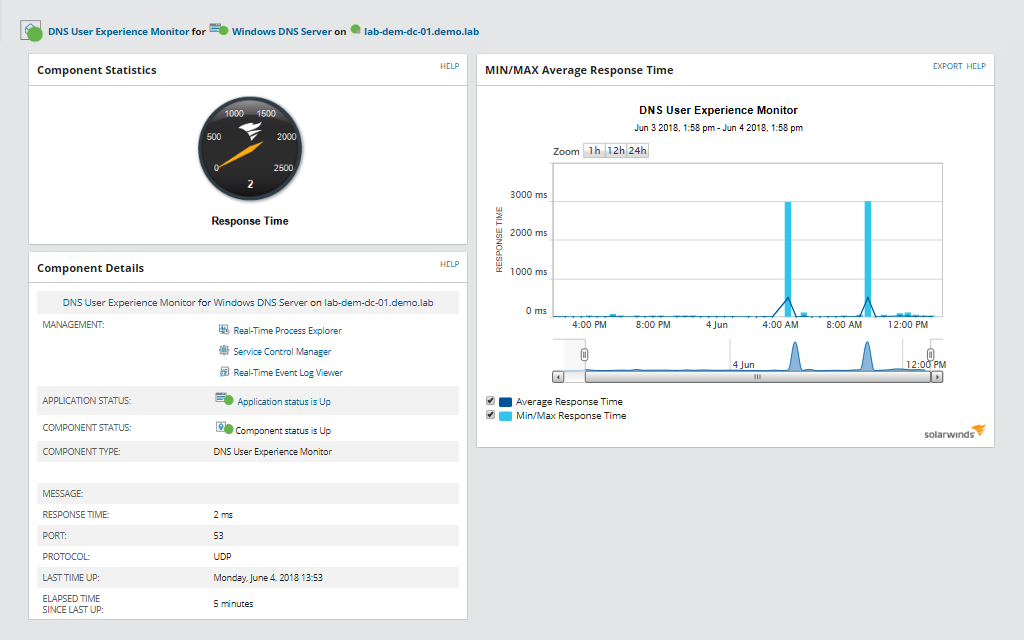
For instant insight into whether the server is responding accurately and quickly to queries, set alerts with the user experience DNS monitoring tool in SolarWinds SAM.
DNS monitoring is the process of inspecting all Domain Name System (DNS) activity to ensure high levels of performance.
DNS is a hierarchical, decentralized naming system for computers and devices connected to the internet. It acts as a distributed directory service to help computers and servers translate commonly used domain names into numerical IP addresses. DNS allows end users to input easily readable host and domain names into a browser, so they don’t have to enter long, cryptic IP addresses.
DNS downtime can have a negative impact across your infrastructure and end users. When the DNS server supporting your organization experiences downtime, services like websites and proxy servers may become unavailable to both clients and employees. As a result, DNS server downtime can negatively affect both worker productivity and lead to poor customer sentiment.
Since DNS server failure has the potential to render a whole network unusable, it’s important to have solutions in place to help prevent and reduce DNS service outages. By monitoring DNS records and activity, you can better ensure the DNS routes traffic properly to sites, web services, or any other electronic communications.
Much like other forms of monitoring, an admin needs to monitor different elements of a DNS server when trying to run a DNS server health check. For instance, the simplest way DNS monitoring systems works is by regularly checking if the DNS server is responding to all DNS queries.
Another way DNS monitoring works is through a process called “basic check.” A basic check involves verifying the connectivity between a network and the configured recursive server. After verifying this connection, a DNS monitoring system will also verify the domain name is being resolved correctly by the server. These verifications offer insights into DNS health factors like failures in the resolution of a domain name or its measured response time.
DNS monitoring also works by checking outgoing traffic volume. A DNS monitoring system should be able to track the volume of internal users who are using the internet based on the number of name resolution requests. Once you have an idea of the standard traffic, you can establish a baseline threshold. When DNS activity exceeds your thresholds, you can investigate why, make necessary changes, and mitigate the risk of downtime.
DNS monitoring is important because DNS performance is critical to your network, servers, and applications.
DNS server monitoring has many benefits, including:
DNS monitoring is also important because slow DNS performance can lead to subpar website performance. This is because DNS queries play an essential role in web traffic management. Faulty DNS queries might prevent visitors from accessing your websites and cause web errors like 404s and incorrect pathways.
Although many organizations rely on external DNS services and hosts, these vendors may not actively perform DNS monitoring. As a result, if a DNS server outage occurs, these organizations won’t possess a thorough understanding of what might have caused the issue or have the insights to understand what might be affecting poor DNS server performance.
A DNS monitoring tool is designed to track DNS requests and servers, so you can spot performance issues and improve DNS health in a proactive manner.
A DNS monitoring tool can run automated and regular monitoring checks to identify any service disruptions or latency issues. These checks can test the time it takes for a DNS server to respond to a record query, so you can improve response times and help keep end users happy.
DNS server tools can help keep DNS servers running by checking hardware performance metrics related to your DNS activity. Monitoring hardware resources that can impact your DNS servers like CPU, memory, and disk for performance issues is helpful, especially when these resources near full capacity.
Most importantly, DNS monitoring tools include alert features to send notifications when a DNS server becomes overloaded with a high volume of requests, so they can make the necessary adjustments to help ensure server performance and resolve availability issues before they affect end users.
Additionally, a hybrid DNS monitoring tool is designed to provide monitoring for Amazon and Azure DNS records in a centralized view without requiring users to login to separate management consoles.
SolarWinds Server & Application Monitor is built to be able to operate as DNS monitoring tool for users who need to improve DNS server performance and health.
With SAM, you can better understand the end user experience by monitoring DNS server ability and measuring how quickly the server responds to a record query. With a better understanding of server response time, SAM can allow teams to set performance baselines to help ensure DNS servers continue to operate at an acceptable speed for end users.
SAM also operates from a centralized dashboard, so you can view all important DNS server performance metrics from a single view. With this improved visibility, you can more easily track the many components of effective DNS monitoring.
DNS monitoring is the process of inspecting all Domain Name System (DNS) activity to ensure high levels of performance.
DNS is a hierarchical, decentralized naming system for computers and devices connected to the internet. It acts as a distributed directory service to help computers and servers translate commonly used domain names into numerical IP addresses. DNS allows end users to input easily readable host and domain names into a browser, so they don’t have to enter long, cryptic IP addresses.
DNS downtime can have a negative impact across your infrastructure and end users. When the DNS server supporting your organization experiences downtime, services like websites and proxy servers may become unavailable to both clients and employees. As a result, DNS server downtime can negatively affect both worker productivity and lead to poor customer sentiment.
Since DNS server failure has the potential to render a whole network unusable, it’s important to have solutions in place to help prevent and reduce DNS service outages. By monitoring DNS records and activity, you can better ensure the DNS routes traffic properly to sites, web services, or any other electronic communications.
Much like other forms of monitoring, an admin needs to monitor different elements of a DNS server when trying to run a DNS server health check. For instance, the simplest way DNS monitoring systems works is by regularly checking if the DNS server is responding to all DNS queries.
Another way DNS monitoring works is through a process called “basic check.” A basic check involves verifying the connectivity between a network and the configured recursive server. After verifying this connection, a DNS monitoring system will also verify the domain name is being resolved correctly by the server. These verifications offer insights into DNS health factors like failures in the resolution of a domain name or its measured response time.
DNS monitoring also works by checking outgoing traffic volume. A DNS monitoring system should be able to track the volume of internal users who are using the internet based on the number of name resolution requests. Once you have an idea of the standard traffic, you can establish a baseline threshold. When DNS activity exceeds your thresholds, you can investigate why, make necessary changes, and mitigate the risk of downtime.
DNS monitoring is important because DNS performance is critical to your network, servers, and applications.
DNS server monitoring has many benefits, including:
DNS monitoring is also important because slow DNS performance can lead to subpar website performance. This is because DNS queries play an essential role in web traffic management. Faulty DNS queries might prevent visitors from accessing your websites and cause web errors like 404s and incorrect pathways.
Although many organizations rely on external DNS services and hosts, these vendors may not actively perform DNS monitoring. As a result, if a DNS server outage occurs, these organizations won’t possess a thorough understanding of what might have caused the issue or have the insights to understand what might be affecting poor DNS server performance.
A DNS monitoring tool is designed to track DNS requests and servers, so you can spot performance issues and improve DNS health in a proactive manner.
A DNS monitoring tool can run automated and regular monitoring checks to identify any service disruptions or latency issues. These checks can test the time it takes for a DNS server to respond to a record query, so you can improve response times and help keep end users happy.
DNS server tools can help keep DNS servers running by checking hardware performance metrics related to your DNS activity. Monitoring hardware resources that can impact your DNS servers like CPU, memory, and disk for performance issues is helpful, especially when these resources near full capacity.
Most importantly, DNS monitoring tools include alert features to send notifications when a DNS server becomes overloaded with a high volume of requests, so they can make the necessary adjustments to help ensure server performance and resolve availability issues before they affect end users.
Additionally, a hybrid DNS monitoring tool is designed to provide monitoring for Amazon and Azure DNS records in a centralized view without requiring users to login to separate management consoles.
SolarWinds Server & Application Monitor is built to be able to operate as DNS monitoring tool for users who need to improve DNS server performance and health.
With SAM, you can better understand the end user experience by monitoring DNS server ability and measuring how quickly the server responds to a record query. With a better understanding of server response time, SAM can allow teams to set performance baselines to help ensure DNS servers continue to operate at an acceptable speed for end users.
SAM also operates from a centralized dashboard, so you can view all important DNS server performance metrics from a single view. With this improved visibility, you can more easily track the many components of effective DNS monitoring.
Server & Application Monitor
Improve your DNS server management with end-user experience monitoring.
Run DNS performance monitoring from a single dashboard.
Leverage helpful DNS server monitoring tools.